

Two years ago a headline on NPR.org caught my attention: “Hollywood Makeovers, Frame by Frame.” It was a Morning Edition report by Susan Stamberg (which you can listen here) about the digital revolution sweeping over Hollywood: the ability to control and manipulate every tiny inch of a film’s frame with the click of a mouse. For years, photographers had been able to do just that with the aid of Photoshop; filmmakers, thanks to post-production companies like Company 3, could now expect the same results:
There’s one more thing digital colorists can do. You know how fashion magazines airbrush those glam cover images? Well, digital coloring turns the airbrush into a tornado. [Company 3’s chief colorist Stefan] Sonnenfeld can erase frown lines, or eliminate 5-o’clock shadow with a digital shave.
[…]Sonnenfeld touched up Cruise’s close-ups [in Mission Impossible III]. He also did a little smoothing on Johnny Depp’s face in Sweeney Todd. In fact, some stars now have digital coloring written into their contracts.
The piece ran on March 18, 2008. Since then, I have noticed with increased frequency the name “Company 3” during the end credits of many, many films. The digital revolution is here.
This morning I noticed a headline on Jezebel.com: “Glee Retouchers Forgot To Take Wrinkles Out Of Jane Lynch’s Reflection In ‘Vogue’ Video.” I couldn’t see the video embedded on Jezebel, since Hulu is not available in France, so I went to the Fox.com website, found the video, and took screenshots. I was simply astounded by it. See for yourselves:
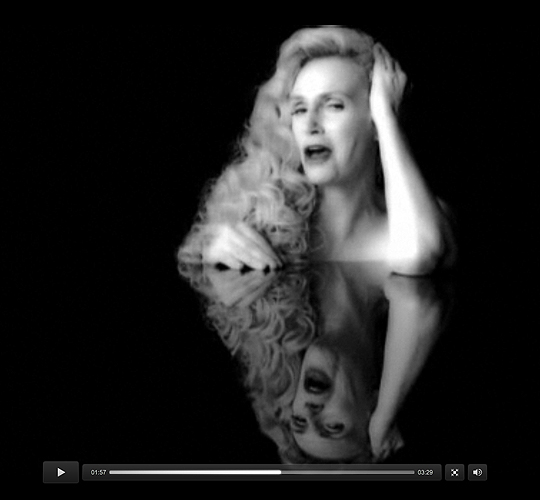
For full effect, I flipped the image upsidedown:

The real face of Jane Lynch, reflected in the mirror, is so strikingly different from the retouched image on top. I am fairly certain that all of Ms. Lynch’s close-ups in the rest of the video were also retouched. How sad. Not for the Vogue video in question, or for the TV show Glee, but rather as a foreshadowing of things to come: as digital technologies become more and more advanced, will we ever see naturally lined faces in the future, or will they completely disappear from TV and films?
I am afraid that the moving image will one day share the same fate as the still images that we see in magazines from Los Angeles to Shanghai – where it is actually impossible to find a woman over the age of 40 with a naturally lined face, all thanks to the “magic” of Photoshop. According to recent studies, our media consumption is increasingly exponentially: we are spending most of our waking lives looking at screens. Think: TV screens, computers, smartphones, iPads and other digital tablets, cinema screens… What will happen to our self-esteem and body image, if in the future all these screens will show people with impeccable complexions, free of lines and blemishes? Technology is certainly pointing in that direction.
Discuss.
It’s strange but I watched that video elsewhere and couldn’t work out why it was unsettling. Now I realise, it’s because I knew the image was supposed to be Jane Lynch but they had doctored her face too much for me to trust the pictures.
If we see more of this then there will be an increased disconnect with what we view as reality and what is on our screens. Hopefully we’ll all get more critical of the faked images we see rather than being depressed by them (perhaps…)
I have many lines on my face. They are hard to accept because, on many levels, I have bought into (or cannot escape) getting older is not acceptable, not good, and definitely, not attractive.
Thanks for your article and the good work you’re doing. Cherry
This post was disturbing 🙁 It must be awful for actors and actresses to see themselves on screen (knowing that their contract requires digital retouching) and barely recognize themselves. Seems like… you’d never want to be seen in public.
Last night I went to the cinema to see the movie The Girl With The Dragon Tattoo. I have read the series of the books and really enjoyed them. The movie of this book has been made in Sweden.
My (girl) friend and I were surprised by the actors chosen to play the male lead role (who we recalled as being quite handsome and a playboy in the book) also his long term lover. To us they did not seem attractive, this is mostly due to the lined, poc marked and scarred face of the male lead. The female girlfriend/publisher also had quite obvious wrinkles in her face. We discussed this afterwards and even chastized ourselves for our expectation of the Hollywood flawless beauty we usually see in the cinema. The movie was good and the characters realistic and it was only the fact that we didn’t see the ‘sex appeal’ of the lead male that lacked credibility!!. Which goes to show, that we have become so convinced that the faces we seen on the big screen should be flawless that when we see real faces we are uncomfortable. Having said that if we had not read the book and didn’t have an expectation of the ‘attractiveness’ of the male lead we would not have been even been bothered by the rough weathered looking character.
I must remember to see more foreign and less ‘hollywood’ movies in future!